
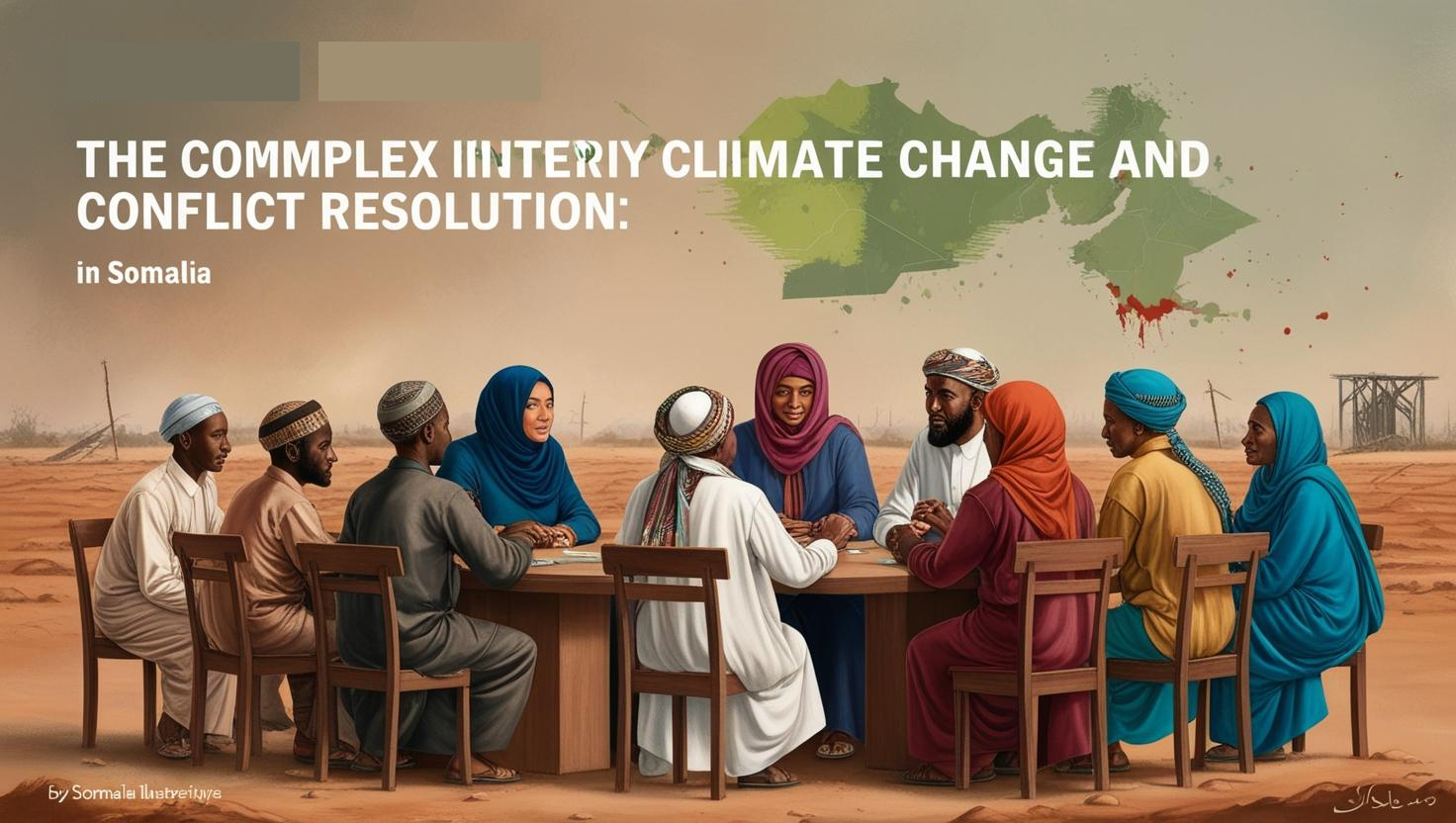
Introduction: A New Generation of Peacebuilders
Did you know that 70% of local conflicts in Somalia are fueled by resource scarcity linked to environmental collapse? (UNEP, 2021) And 60% of Somalia’s workforce depends on climate-sensitive sectors like agriculture and pastoralism. 40% drop in violent clashes reported in districts participating in youth-led climate peace efforts. (Galkio Peace Committee, 2015). Did you also notice that there has been 3x faster growth in youth-led eco-enterprises than in traditional agriculture sectors post-initiative in the last 3 years?
For decades, the global narrative about Somali youth has been painfully reductive, casting them mainly as casualties or catalysts of crisis. The images that flash across international news screens reinforce this limited view: young boys wielding rifles as child soldiers, gaunt faces in overcrowded refugee camps, crumbling cities scarred by years of violence. In these portrayals, Somali youth appear trapped as either victims of forces beyond their control or threats to international security. Rarely are they seen as leaders, innovators, or architects of a better future.
Yet beneath this grim surface, something extraordinary is happening, often unnoticed by the world’s gaze. Across Somalia’s fractured landscape, from the sun-scorched plains of Puntland to the lush but increasingly vulnerable riverbanks of Jubaland, a quiet but powerful transformation is taking root. A new generation of Somalis is stepping forward not with weapons or slogans but with farming tools, solar panels, and seedlings in hand. They are trading fear for innovation, despair for action, and conflict for cooperation. In some of the most challenging environments on Earth, they are sowing the seeds of peace, resilience, and renewal.

This movement goes far beyond environmental activism; it is an existential response to intertwined crises. It is about survival in a country where the United Nations estimates that more than 7.8 million people are in need of humanitarian assistance, much of it driven by climate-related disasters. It is about rebuilding communities that have been torn apart by decades of mistrust, violence, and scarcity. And it is an act of resistance against both the immediate devastation of climate collapse and the deeper, slower erosion of hope that prolonged conflict brings.
The stakes could not be higher. Data shows that approximately 70% of local conflicts are fueled by competition over dwindling resources: water points, grazing lands, and arable soil resources that are vanishing under the pressure of droughts, desertification, and floods. Youth activists understand an essential truth that policymakers and power brokers often miss: that restoring ecosystems is not separate from restoring peace. The two are inseparable. A thriving pasture can mean the difference between negotiation and war; a functioning solar well can defuse a potential clash between herders before it ignites. Their vision is radical in its simplicity. Every sapling planted is a commitment to a shared future. Every rehabilitated riverbank is a safeguard against the next disaster. Every job created in a green economy pulls a potential recruit away from the allure of militias. In a place where ceasefires are fragile and external interventions often falter, youth-led environmental climate security offers a durable, ground-up pathway to peace.

What is unfolding in Somalia is not an isolated phenomenon. From the Sahel to Afghanistan, the world is grappling with the same deadly equation: climate change as a threat multiplier for violence. As droughts grow longer, rains become less predictable, and arable land shrinks, the competition for survival can tear at already fraying social bonds. Traditional conflict resolution mechanisms often struggle to keep pace with the speed and scale of environmental collapse. In this global context, Somalia’s youth are offering something profoundly valuable: not a theory, but a living, breathing example of resilience in action.
Their work sends a message that demands attention: the solutions to our intertwined climate and conflict crises will not come solely from international treaties or military interventions. They will come from empowering those closest to the land, those who have the most at stake, and those who have the vision and will to imagine a different future. Somalia’s youth are showing that peace can be planted, nurtured, and grown even in the most unlikely soil. They are not merely rewriting their own narrative. They are offering the world a critical blueprint for survival.
The Climate-Conflict Nexus in Somalia
How Environmental Collapse Fuels Violence
Few places illustrate the deadly link between climate collapse and violence as vividly as Somalia. Once-fertile lands, sustained for centuries by nomadic herders and smallholder farmers, have been decimated by decades of drought, deforestation, and increasingly erratic weather patterns. As pastures turn to dust and rivers run dry, the competition for survival has become fiercer. Pastoralist communities, whose livelihoods depend on access to grazing land and water, are often forced into confrontations with neighboring clans. These clashes, fueled by desperation and scarcity, frequently escalate into protracted conflicts.

Longstanding clan disputes, once manageable by traditional mechanisms of negotiation and compromise, have become flashpoints for violence when the resources at the center of these disputes vanish altogether. According to the UN Environment Programme, more than 60% of Somalia’s conflicts today are directly linked to issues of land degradation and water scarcity. When the environment fails, entire communities lose their sources of food, income, and identity. Without alternatives, the only options that remain are migration, fighting, or falling into the hands of militant groups. Environmental collapse doesn’t just destroy nature; it unravels the very fabric of society.
Youth as Solution Architects
Faced with these grim realities, Somali youth are refusing to accept a future dictated by scarcity and conflict. Rather than waiting for others to step in, they are designing and implementing their own solutions that address both the environmental and social dimensions of the crisis. In contested border regions where distrust runs deep, youth-led “peace trees” are taking root. These trees, carefully planted and maintained by young volunteers from rival clans, serve as neutral spaces where dialogue can happen. Through working side-by-side to heal degraded landscapes, former adversaries are building new relationships based on cooperation rather than competition. In many cases, these initiatives have succeeded where formal peace talks have failed, simply because they ground reconciliation in shared, tangible projects.
Economic empowerment is another critical strategy. Through creating green livelihoods training youth as solar energy technicians, eco-farmers, conservation workers, and agroforestry entrepreneurs, young activists are offering their peers a viable alternative to the militant economy. Every solar-powered well or organic farm that succeeds chips away at the desperation that fuels violence. Technology is also playing a transformative role. Somali youth innovators are building mobile apps that issue flood early warnings, helping farmers and herders make informed decisions and prevent disputes over emergency resources. GPS mapping projects are being used to delineate grazing zones and monitor land use, providing a scientific basis for negotiations that once relied solely on oral claims and clan memory.
As Naima, a 24-year-old leader of the Jubaland Climate Collective, says, “We don’t just want to stop fighting—we want to remove the reasons to fight.”
Case Study: The Fahan Youth Movement Greening the Frontlines
Where Bullets Once Flew, Trees Now Grow
Nowhere is the transformational power of youth-led environmental peace-building more visible than in Galkio, a city historically torn apart by clan warfare. In a region where even, basic coexistence once seemed impossible, a coalition of young activists launched the “Trees Over Trenches” initiative. Their goal was simple yet revolutionary: to turn former battlefields into orchards, to transform places associated with death into spaces teeming with life.

Over a period of just a few years, the group planted more than 50,000 drought-resistant trees across conflict-ravaged zones. These trees were not chosen randomly; local species with deep roots were selected to withstand harsh climates and prevent soil erosion, thus offering both environmental and symbolic stability. Former fighters, many of them young men once conscripted by militias, were recruited and trained as “Green Guardians.” Their task was to protect these new forests, but also to protect the fragile peace growing alongside them.
The impact of the Trees Over Trenches campaign has been profound. According to the Galkayo Peace Committee, participating districts saw a 40% drop in violent clashes within two years. Moreover, the initiative generated over 200 new jobs, from nursery management to land rehabilitation, offering economic alternatives to the cycle of violence. Peace dialogues are now regularly held under the acacia trees planted by the movement, providing a powerful metaphor for the change taking place.
As Halima, a peace volunteer from Jubbaland, put it, “We used to fight over this land. Now we share its shade.

Naima Hassan — “Fighting Drought, Planting Peace”
At just 24 years old, Naima Hassan from Kismayo, Jubaland, is already one of Somalia’s leading voices on climate resilience and peacebuilding. Growing up amid the twin devastations of drought and conflict, Naima understood early that survival wasn’t enough her generation had to find a way to heal both the land and their divided communities. As a founding member of the Jubaland Climate Collective JCC, Naima helped pioneer “peace forests” neutral green spaces planted by youth from rival clans to facilitate dialogue and trust-building. Her team also developed a mobile flood alert system, which notifies farmers and pastoralists of rising water levels, helping avert deadly clashes over emergency river access during the rainy season.
Despite receiving threats for her leadership role in a male-dominated society, Naima remains undeterred. “Every tree we plant is a vote for peace,” she says. “Every time we meet under the shade of an acacia tree we planted together, we remember that the future is something we can grow, not something we have to fight for.” Today, Naima trains other young women in agroforestry and environmental mediation, making sure that Somalia’s green peace movement is not only youth-led but also women-led.
Beyond Trees: Solar Wells and Waste for Peace
The Fahan movement is not an isolated success. Across Somalia, youth are spearheading similarly creative, locally rooted climate-peace initiatives. In Puntland, groups of young pastoralists, nicknamed the “Solar Shepherds,” have come together to install solar-powered wells in remote areas. These wells eliminate the need for seasonal migrations that often led to violent clashes over water access, anchoring communities and reducing tensions. In the capital city of Mogadishu, another youth collective known as “Waste for Peace” is tackling two challenges at once: environmental degradation and post-war reconstruction.
Former street children now work together to collect and recycle plastic waste, converting it into affordable building materials used to repair homes and infrastructure damaged during decades of conflict. Through their work, they are not only cleaning up their city but actively rebuilding it. Meanwhile, in the riverine communities of Beledweyne, young mediators are using mobile flood alerts to coordinate resource sharing among clans before scarcity triggers violence. Through anticipating environmental crises and preparing cooperative responses in advance, they are demonstrating that foresight, not firepower, is the key to resilience.

Challenges and the Way Forward
Funding, Fear, and Sabotage
Despite the success stories, youth-led climate peacebuilding in Somalia faces enormous challenges. Extremist groups like Al-Shabaab see reforestation projects and green livelihoods as direct threats to their influence. In some areas, militants have deliberately destroyed saplings and attacked organizers, aiming to crush hope before it can take root. Financial support remains another major barrier. Most youth initiatives operate on shoestring budgets, sustained by small, inconsistent grants from sympathetic NGOs. Systemic government backing is almost nonexistent, and while international donors often praise youth-led resilience rhetorically, few have translated those words into sustained investment. Gender dynamics add another layer of difficulty. Female activists, in particular, risk harassment and violence, not only from extremists but also from conservative elements within their own communities who view leadership by young women as a dangerous break from tradition. Yet these women continue to lead with remarkable courage, often at great personal cost.
Conclusion: A Blueprint for the World?
Somalia’s youth are doing more than surviving in the face of crisis—they are pioneering a new model for peace in an era where climate change and conflict are increasingly intertwined. Their approach merging environmental climate security, social healing, and economic hope proves that another future is possible even in the most fragile states. This model has applications far beyond Somalia. In the Sahel, in Yemen, in parts of Afghanistan, similar dynamics between environmental collapse and social breakdown are fueling cycles of violence. The Somali experience suggests that the antidote is not only humanitarian aid or military intervention, but the empowerment of young people to heal their land and, in doing so, heal their societies.
As Fadumo, a leader of the Fahan Youth Movement, says, “We don’t just want to survive; we want to rewrite our future.” The world would do well to listen.
Call to Action
To move from isolated successes to systemic change, Somali youth initiatives need extensive, strategic investment. Building a national network of “climate peace hubs” centers that integrate environmental climate security, economic opportunity, and conflict mediation training would allow local efforts to scale and reinforce each other. National policy frameworks like Somalia’s Climate Adaptation Plans must formally recognize and resource youth leadership, treating young activists not as beneficiaries but as partners. International solidarity is equally crucial. Somali youth should be linked into broader climate justice movements, allowing them to share strategies, receive training, and access funding pipelines that currently by pass grassroots efforts.
Somalia’s young peacebuilders are lighting a path that others can follow but they cannot do it alone. Supporting local Somali youth initiatives can provide the resources needed to expand their impact. Sharing their stories under campaigns like #ClimateOfHope can shift public narratives away from despair toward resilience. And perhaps most importantly, communities around the world must ask themselves: could we adapt their strategies to our own challenges? In an age dominated by stories of collapse, Somalia’s youth are reminding us that even in the ashes of war, something beautiful and lasting can grow. It only needs the chance and the support to take root. These young people have shown they can build peace from the ground up. Now it’s time for the world to stand alongside them.
Written By: Shakiib Ahmed
