
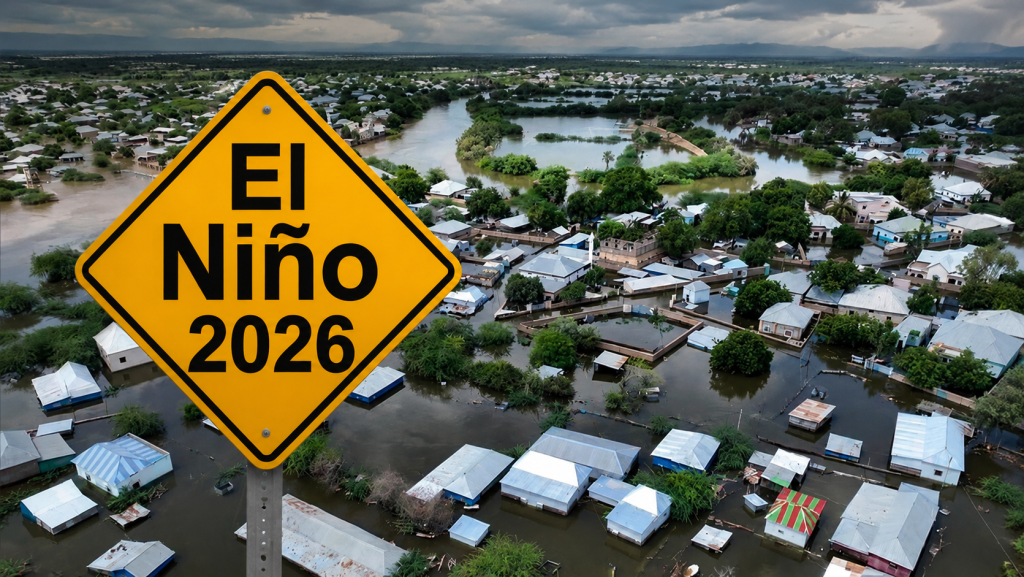
A strong El Niño is building toward October. Somalia’s recent history shows what could happen and how much depends on whether warnings reach people in time.
Somalia is preparing for what forecasters call one of the strongest El Niño events in decades. Over the past five years, the country has swung between severe drought and heavy flooding. Tens of thousands of people have died. Millions have been forced from their homes. As the 2026 El Niño grows stronger, the real question is not whether Somalia will be hit by extreme weather. It is whether the country’s warning systems can act early enough to save lives, instead of responding after the damage is done.
Five Years, Two Extremes
Between 2021 and 2023, Somalia went through its worst drought in decades. Five rainy seasons in a row failed. According to a joint study by UNICEF and the World Health Organization, carried out by the London School of Hygiene and Tropical Medicine and Imperial College London, about 43,000 people died from drought-related causes in 2022 alone. Half of them were children under five. The same study warned of a further 18,100 to 34,200 deaths in the first half of 2023. By early 2023, more than 1.4 million people had been displaced and at least 3.5 million livestock had died, according to a Joint IDP Profiling Service assessment. Somalia’s population is estimated at around 19–20 million people, according to World Bank and UN figures. That means roughly 1 in every 14 Somalis was displaced by the drought alone.
The drought had barely eased when disaster struck from the opposite direction. Heavy Deyr rains between October and December 2023, made worse by a strong El Niño, caused major flooding. According to OCHA Somalia’s situation reports, citing figures from the Somalia Disaster Management Agency (SODMA), 2.48 million people were affected, 1.2 million were displaced, and at least 118 people died. A later assessment cited by Mohamed Okash, Founding Director of the Institute of Climate and Environment (ICE) at SIMAD University, puts the toll higher 188 lives lost, with an estimated US$176 million in damages and recovery needs of over US$230 million. That means roughly 1 in every 8 Somalis was affected by flooding in a single three-month season. Floodwater submerged parts of 33 of Somalia’s 74 districts and destroyed bridges in Luuq and Baardheere, cutting off tens of thousands of people who needed evacuation by boat, according to OCHA. Cholera and acute watery diarrhea cases rose sharply as displaced families crowded into camps with poor sanitation.
Put together, the last five years show a hard pattern: a multi-year drought that killed tens of thousands, followed within months by a major flood that displaced over a million more people who had barely begun to recover. As of July 2026, nearly four million people close to 1 in every 5 Somalis remain internally displaced nationwide, according to SODMA.
Read our previous Somali article on El Niño and how it may affect your community: El Niño 2026: Roobab Xooggan oo Suurtagal Ah Xilliga Deyrta.
A Familiar Threat Returns, at a Larger Scale
Forecasters warn history may repeat itself. According to the World Meteorological Organization, a strong El Niño is expected to keep growing through August–October 2026, with sea-surface temperatures forecast to rise more than 2.9°C above normal. The WMO says the Greater Horn of Africa, including Somalia, is likely to see heavier-than-normal rains as the event builds. The US Climate Prediction Center goes further, giving an 81 percent chance this El Niño becomes one of the strongest since 1950, peaking between October and December. The International Rescue Committee lists Somalia among the countries most at risk, alongside Kenya, Uganda, Pakistan and Afghanistan.
Somali officials are responding publicly. In July, SoDMA Commissioner Mahmoud Moallim Abdulle warned that the coming rains could flood Mogadishu, Baidoa and river communities, and said the impact could be worse than both the 2023 floods and the historic 1997 El Niño floods. He said nearly four million people already displaced across the country are especially at risk, since many live in weak shelters. According to SODMA, the Ministry of Agriculture and Irrigation has outlined a preparedness plan involving food distribution, rescue boats, emergency equipment, and identifying higher ground for evacuations.
In August, SoDMA brought together federal ministries, state and independent media, and telecom companies to strengthen cooperation ahead of the forecast rains. Officials said past warnings had not always been taken seriously by the public and called for more consistent messaging through both traditional and digital media, journalist training on disaster reporting, and translating warnings into local languages, including Maay, so they reach high-risk communities.
What an Independent Assessment Found
Somalia’s own national planning process has already looked at this gap. According to Mohamed Okash Somalia’s 2023 Rapid Post-Disaster Needs Assessment found that the country’s disaster management system remains heavily focused on emergency response, while preparedness, prevention and disaster risk reduction receive comparatively less attention. The assessment called for a more integrated, all-of-society approach that strengthens institutions and builds resilience into long-term development planning, not just emergency relief.
There are signs this is starting to shift. At a Country Humanitarian Forum convened by SODMA in June 2026, government, humanitarian agencies, donors, civil society and the private sector committed to moving from reactive response toward preparedness, anticipatory action and early warning, Okash writes. The ICE Institute’s own policy paper, Anticipating El Niño: Building Climate Resilience and Economic Stability in Somalia, argues that reducing flood risk requires tackling root causes weak coordination between sectors, degraded river systems, and unplanned urban growth not just responding once the rain falls.
Separately, Somalia has been building a National Multi-Hazard Early Warning System under SODMA, established through Law 17/2016. In 2024, the country held its first National Consultation on Early Warnings for All, led by the Ministry of Humanitarian Affairs and Disaster Management together with SODMA. That process led, in June 2026, to the formal launch of Somalia’s Early Warning for All initiative, backed by a $12.7 million Green Climate Fund grant and run by UNDP together with SODMA, WMO, the International Telecommunication Union, and the IGAD Climate Prediction and Applications Centre (ICPAC).
Technical reviews of SODMA’s early warning center have found ongoing gaps in ICT infrastructure, network connectivity and trained staff gaps that slow down how fast a forecast becomes an actual alert people can act on. The 2023 floods show the cost of that lag: displacement rose from around 113,000 people in early November to over 1.2 million by December, according to OCHA, a pace that outran real-time monitoring at the time. One working example of what prevention can look like is the World Food Program’s flood anticipatory action programme with SODMA, Africa’s first of its kind, where early warning radio broadcasts reached more than 442,000 people ahead of flooding.
What Somalia Needs Now
Somalia’s last five years show that a warning only works if it reaches the right people early enough, in a language they trust, with a way to act on it. A few priorities stand out.
Reach people directly, not just through national broadcasts. Riverine and pastoral communities were hit hardest in 2022 and 2023, yet they are often the last to get formal warnings. Mobile alerts, community radio, and messages in Maay and other local languages need steady funding, not one-off campaigns.
Fund the response before the rain falls, not after. The 2023 flood response was only 42.7 percent funded, according to OCHA, by the time the emergency peaked. Anticipatory funding tied to forecast triggers, like WFP’s model, should be expanded across the country before El Niño peaks in October.
Keep closing the early warning center’s technical gaps. SODMA’s early warning system needs the same investment as its emergency response arm, so forecasts turn into alerts fast enough to matter.
Built on the shift already underway. SODMA and its partners have publicly committed, through the June 2026 Country Humanitarian Forum and the Early Warning for All initiative, to move toward prevention. The task now is turning that commitment into steady, year-round funding and staffing not just stronger relief operations for when the warnings, once again, arrive too late.
With a strong El Niño already building and forecasters warning it could exceed 2023, Somalia has a narrow window to show that the lessons of the last five years are being put into practice not just written down.
———
Fartun is an MSc candidate in Disaster Education and Management at Çanakkale Onsekiz Mart University, Türkiye, with a background in emergency aid and disaster management.
